
'While every year presents new challenges, it also provides opportunities for better growth and performance.'

'Which is growing fast and where we are very strongly positioned.'

Consumer goods firms and auto companies are witnessing an upturn in rural demand, which had been lagging for most of FY24. Expectations of a bumper rabi crop harvest have helped turn the tide. The Reserve Bank of India's (RBI's) Monetary Policy Committee kept the repo rate unchanged last week, noting that as rural demand catches up, consumption is expected to support economic growth in 2024-25.

Fast-moving consumer goods (FMCG) companies anticipate sustained volume pressures in the January-March quarter (Q4) coupled with sluggish rural growth during the period. Brokerages estimate top-line growth to be in low single digits in the quarter. Also, the late onset of winter had an impact on demand for winter products which range from moisturisers to hot beverages.
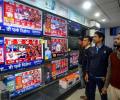
Consumers may have to shell out more to buy television panels as manufacturers say they may raise prices again in April. The industry has been facing this issue of price rise post the pandemic and open cell prices have gone up by around 30 per cent in the last one year. And, television panel manufacturers expect this trend to continue.

Rasna, which became a household name in the 80s and 90s and is still ruling the pre-mix market, is now looking at overseas franchise arrangements for manufacturing abroad. As part of the arrangement, the franchisee would invest in the plant and machinery and it would also take care of day-to-day operations. Rasna would supply the pre-mix, technical know-how and some financial support.

Whether the age-old cry of kendrer banchana will be able to drown out pangs of Sandeshkhali, the EVM will tell.

Furniture retailer Ikea India on Thursday said it will shut down its store in Mumbai's R City Mall by the middle of this year and explore omnichannel formats in the city. The store at R City Mall, which is spread across 72,000 sq ft, opened in June 2022 to test the viability of small-format stores. The company's plan to shut down the store illustrates the concerns surrounding the viability of running a small-format store, given the rising rentals.

VFS Global expects visa applications from India to surpass pre-pandemic levels in 2024 with the easing of appointment availability. Vishal Jairath, head-South Asia, VFS Global, said during a media interaction that based on indications from the client governments in terms of appointment availability and the resources deployed by them, visa applications would surpass the pre-Covid levels by a healthy margin. "We have geared up. We have looked at our infrastructure and increased capacity in many locations," he added.

Sanjiv Puri, chairman and managing director of ITC, is looking to expand the conglomerate's play outside India by taking "strategic positions" in markets close to home in the non-cigarette fast-moving consumer goods (FMCG) and hospitality businesses. In a recent conversation with Business Standard, Puri revealed that ITC is setting sights beyond India's borders. "We already export to 100-odd countries. We want to scale that up and take some strategic positions in markets close to us," he said.
'In staples, we have still managed in rural areas.'

'The UK is more of a structural problem, and that's why we're doing the restructuring.'

It's mid-morning and the two-kilometre stretch from Rashbehari Avenue to Gariahat Market is bustling with activity. Dotted with saree shops and hawker stalls that sell everything, from hairpins, hangers and towels to hosiery, mobile phone covers and kurtas, this is one of South Kolkata's busiest shopping areas. And it is beginning to wake up to the Paytm crisis.

In India, fast-moving consumer goods (FMCG) majors continue to hold sway, with incumbent brands cornering 65 per cent of the market share, shows a Bain & Company report. While identifying the continued preference of Indians for incumbent brands, the report says that the dominance of general trade in the country has allowed national brands to maintain their supremacy. The low penetration of e-commerce in the country has also helped large brands.

'On the final product, there can be an increase of a minimum of 10 per cent in February and March.'

'Will make sure that we create value. We will again look for organic and inorganic opportunities.'

As Ayodhya readies itself for the glittering, much-awaited consecration ceremony of the Ram Mandir on January 22, and as millions of pilgrims and devotees pour into the holy city for the momentous event, companies are rushing to do their bit and be a part of the mega celebrations. Some are offering a part of their profits as donations, telcos are beefing up the number of cellular towers to ensure better connectivity, and there are those distributing jalebis and food platters.

Retail companies are expected to witness a tepid strong same-store sales growth (SSSG) expansion in the third quarter (October - December) of the current financial year (Q3FY24) on the back of subdued sales in the festival season. The third quarter of the financial year typically witnesses higher sales since it coincides with the festival season. This time around, weak customer sentiment has dragged down SSSG.

Geopolitical headwinds leading to lower demand from export markets, coupled with lower domestic buying, have dragged the auction average of Darjeeling tea to its lowest level since 2015. Data from Calcutta Tea Traders Association (CTTA) shows that the average price of Darjeeling tea at Kolkata auctions for January-December 2023 was Rs 319.74 per kg. The last time it dipped below this level was in 2015 at Rs 285.71 per kg.

A young couple sharing a laugh - in the living room over a Polish joke book, on the beach, in the rain - with the tagline, "Made for each other", hung from billboards at prominent street corners from the 1960s to the 1990s. It was a campaign for one of the largest selling cigarette brands in India, Wills (Navy Cut) from the ITC stable, that resonated with a generation of smokers and non-smokers alike till the curtains came down on tobacco advertising in 2004. As we prepare to welcome 2024, ITC has metamorphosed from a tobacco giant into a conglomerate straddling multiple large-sized businesses. In the mind space of Gen Z or millennials, the company represents a gamut of branded products - from frozen food (ITC Master Chef), noodles (YiPPee!), and cookies (Sunfeast) to snacks (Bingo!) and notebooks (Classmate), and so on and so forth.
 © 2025 Rediff.com - Investor Information - Advertise with us - Disclaimer - Privacy Policy - Sitemap - Feedback - About us - Terms of use - Grievances